I Spent 3 Months Trying to Index My Ghost Blog. Here’s Why I Failed.
I had an established Medium presence and a loyal social following. I thought a personal website was the next logical step for monetization. I was wrong.
wasn’t a beginner when I decided to launch my own site.
For years, I had been building a name on Medium. I had articles with real traction — technical deep-dives on Flutter that developers actually read.
I had a distribution engine that worked; every time I posted, I’d see clicks coming in from LinkedIn, X (Twitter), Reddit, and Discord. I was already doing the “work.”
But I had a nagging feeling that I was building on rented land.
I wanted to monetize the “non-member” readers who found my stuff through my social links. I wanted to hedge against Medium’s unpredictable algorithm changes.
So, in late 2025, I did what every “pro” blogger tells you to do: I launched my own kingdom on Ghost.
I thought I was graduating. In reality, I was just handing myself a second full-time job I didn’t have time for.
The Dream: Diversification and the $5,000 Goal
My plan for theWatcherLabs was simple:
- Monetize the “Gaps”: Capture ad revenue from the thousands of non-member developers clicking my links who didn’t want to pay for a Medium subscription.
- SEO Independence: Use my 30+ high-quality technical posts to build a long-term organic search asset.
- The “Journey”: Hit the 1,000-session threshold to qualify for Journey by Mediavine, the 2026 “on-ramp” for smaller technical sites.
I had the content. I had the social “juice.” I had 502 sessions a month just from my personal network. All I needed was for Google to notice me.
That’s when the technical reality of 2026 hit me like a production-breaking bug.
The Crisis: 30 Posts, 0 Indexing, and the “Sitemap Shadow”
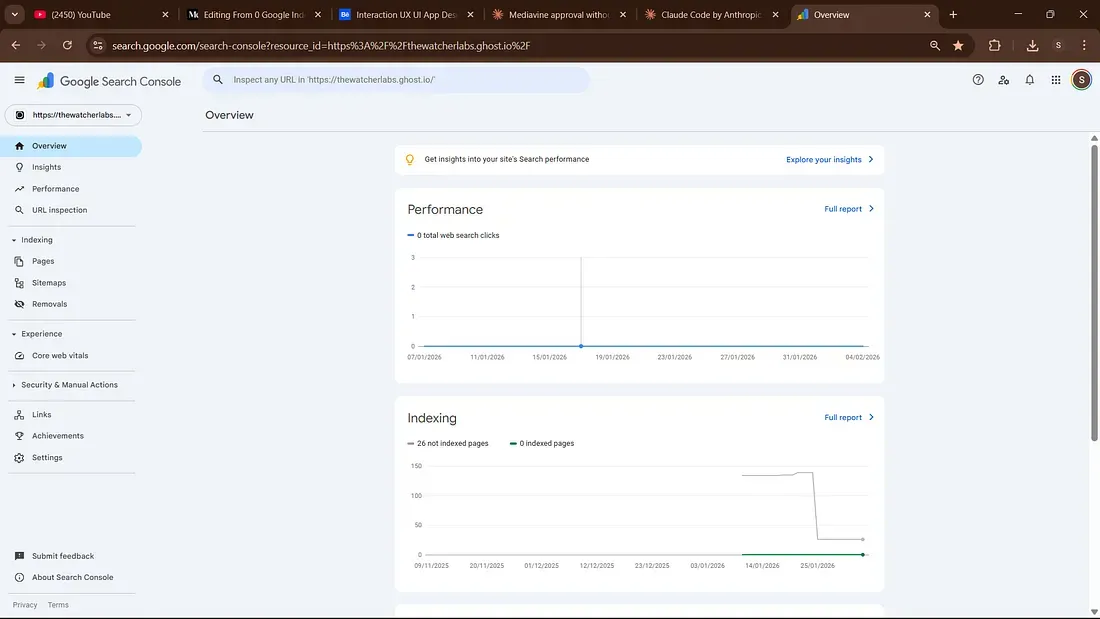
I opened Google Search Console in early January expecting to see a slow upward climb. Instead, I saw a flatline.
GSC told me it had “Discovered” 134 pages on my site but had only bothered to crawl 24 of them. The number of indexed pages? Zero.
I went into full-on engineer mode. I checked the robots.txt (perfect). I checked my Ghost metadata (spotless). I used the URL Inspection tool to find out why my homepage wasn't showing up, and that’s where I found the smoking gun:
“No referring sitemaps detected.”
Google was finding my posts through my social links and internal cross-linking, but it was treating them like isolated “Gists” rather than a cohesive authority site.
It was crawling my pages, looking at my deep dives on Flutter Interceptor Patterns and Ottu Payment Gateway integrations, and deciding: “Not worth the index space.”
In the post-December 2025 Core Update world, Googlebot is a snob. It doesn’t care if your content is “good”; it cares if your domain has Authority. As a brand new subdomain on .ghost.io, I had none.
The Realization: The Brutal Math of a Part-Time Creator
I have a full-time job. I have side projects. I have a life.
One night, while I was manually requesting indexing for my 31st post instead of actually coding, I realized I had fallen into the “Infrastructure Trap.”
I was paying $20 a month for a Ghost subscription to reach an audience I already had on Medium.
I was spending 10+ hours a week troubleshooting technical SEO instead of writing the technical stories my audience actually cared about.
The ROI was devastating:
- Medium: 0 Technical overhead. Instant indexing. Built-in distribution.
- Ghost: $240/year. 20+ hours/week of “SEO labor.” 0 Organic growth after 90 days.
I realized that for a part-time creator, “Owning your platform” is often just another way of saying “Maintaining your own obstacles.”
The Pivot: Why “Sustainable Suboptimality” is My New Strategy
I’m not giving up on my personal site, but I’m changing its role. I’m moving back to a Medium-First model.
1. Medium is the “Discovery Engine”
Medium’s internal recommendation algorithm is the only place where a technical post can get 10,000 views without me spending 5 hours on Reddit promotion. In 2026, you don’t build an audience; you borrow one.
2. The Portfolio Model
I’m keeping my original Ghost URLs and using canonical links on my Medium posts.
This tells Google, “Hey, the ‘official’ version is on my site, but feel free to rank this Medium version so people actually find it.” This protects my long-term SEO equity while using Medium’s domain authority as a shield.
3. Owning the Relationship (Not the Server)
Instead of fighting Google for “sessions,” I’m focusing on Email Subscribers. I’ll be using a Substack or Beehiiv lead magnet inside my Medium posts.
If Medium changes its rules tomorrow, I have my list. I don’t need to pay $20/month for a CMS to do that.
The Hard Lesson: Content is No Longer a Moat
If you’re a developer planning to launch a blog in 2026, hear this: Your technical knowledge is not your moat.
AI Tools can summarize “How to use BLoC” in three seconds. If your blog just explains concepts, you’re competing with a machine that never sleeps.
The only thing AI can’t fake is Experience.
When I wrote about integrating the Ottu payment gateway, I didn’t just share code. I shared the fact that their SDK was crashing, it wasn’t on pub.dev, and I had to pivot to a WebView interceptor pattern to hit a one-week production deadline.
That story — the stress, the specific tradeoffs, the “shipping over perfection” mindset — is the only reason people read my blog instead of asking ChatGPT.
My Advice to You
- Don’t outrun your constraints: If you have a job and side projects, don’t buy a CMS that requires 20 hours of SEO work.
- Authority > Quality: Google trusts established domains (Medium/Stack Overflow) more than your quality code. Use that to your advantage.
- The “Wikipedia Test”: If your post could be written by AI using only documentation and Wikipedia, don’t hit publish. Go deeper into your failures.
I started this journey wanting to reach 50,000 sessions on my own site. I ended it realizing that 1,000 engaged readers who trust your experience are worth more than 50,000 random hits from Google.
For me, Medium is where those readers are. Where are yours?
Are you struggling with independent blog indexing? Or are you finding that social media traffic is the only thing keeping your site alive? Let’s chat in the comments.